
A few years ago, as part of my MBA research, I spent time with leaders from eight UK B Corps. I wanted to know how they made strategic decisions day to day, not what their strategy documents said, but how they actually navigated strategic challenges as they arose.
What I found surprised me a little, and it has stayed with me ever since.
None of them talked about strategy the way business schools teach it. Nobody revered the annual planning cycle, and nobody was anxious about getting the deck right. One leader put it about as plainly as you can: strategy is just how we achieve our objectives. Another told me, only half-joking, that when it came to documents, they were “pretty much shooting from the hip”.
That could sound careless. It wasn’t. Beneath the informality, each of them was holding something far more disciplined.
Two pictures, held as one
The first thing they held was a long view. Most of them thought in decades, working backwards from a ten-year picture of where they wanted to be, then breaking it down into five years, three years and one year.
The second was just as important and, in my experience, far rarer: an honest read of where they stood today. One leader said it always astonished her how few organisations genuinely agree on where they are now, and how powerful it becomes once they do.
For these leaders, strategy was the path between those two pictures. Present state and desired state. Where they were and where they were heading formed a single picture, sensed and adjusted simultaneously.
That’s the distinction I keep coming back to with clients, between strategy as a document and strategy as a direction.
A document is complicated. It can be right or wrong, finished or unfinished, filed away and forgotten. A direction is complex. It has to be held, sensed and adjusted all the time, because the territory it describes keeps moving. Five-year plans and tidy charts are comforting precisely because they look finished. The leaders I spoke to had mostly let go of that comfort in exchange for something much more alive: a running check of where they were against where they meant to go.
This sits at the heart of Systemic Navigation. We call the long view a Systemic North Star, a direction clear enough to steer by and held loosely enough to learn from. And we treat an honest, shared map of the present as the place every journey has to start. Navigators steer by a heading and keep checking their position, adjusting as the ground shifts beneath them.
Where the rigour lives
One participant, a management consultant by background, was unusually candid about the trade-off. He respected the craft of walking people analytically from A to B. But what interested him more was getting people in a room, having the harder conversation, making them a little uncomfortable, and moving them. “If you can move people in a direction”, he said, “you don’t have to do the charts”.
That’s still rigour, just in a different place. The hard work goes into the thinking, and into the conversations where a direction actually takes shape. The document then only needs as much detail as the situation calls for, in whatever form suits the leader who steers by it.
A model that outgrew its question
My original research question was narrow. I was exploring whether the characteristics of wisdom described in organisational theory showed up in how B Corps practise strategy. They did, clearly. What came out the other side, though, was a conceptual map of how they did it, and it has little to do with certification. It’s a useful map for any organisation that wants to pursue a strategy towards the common good.
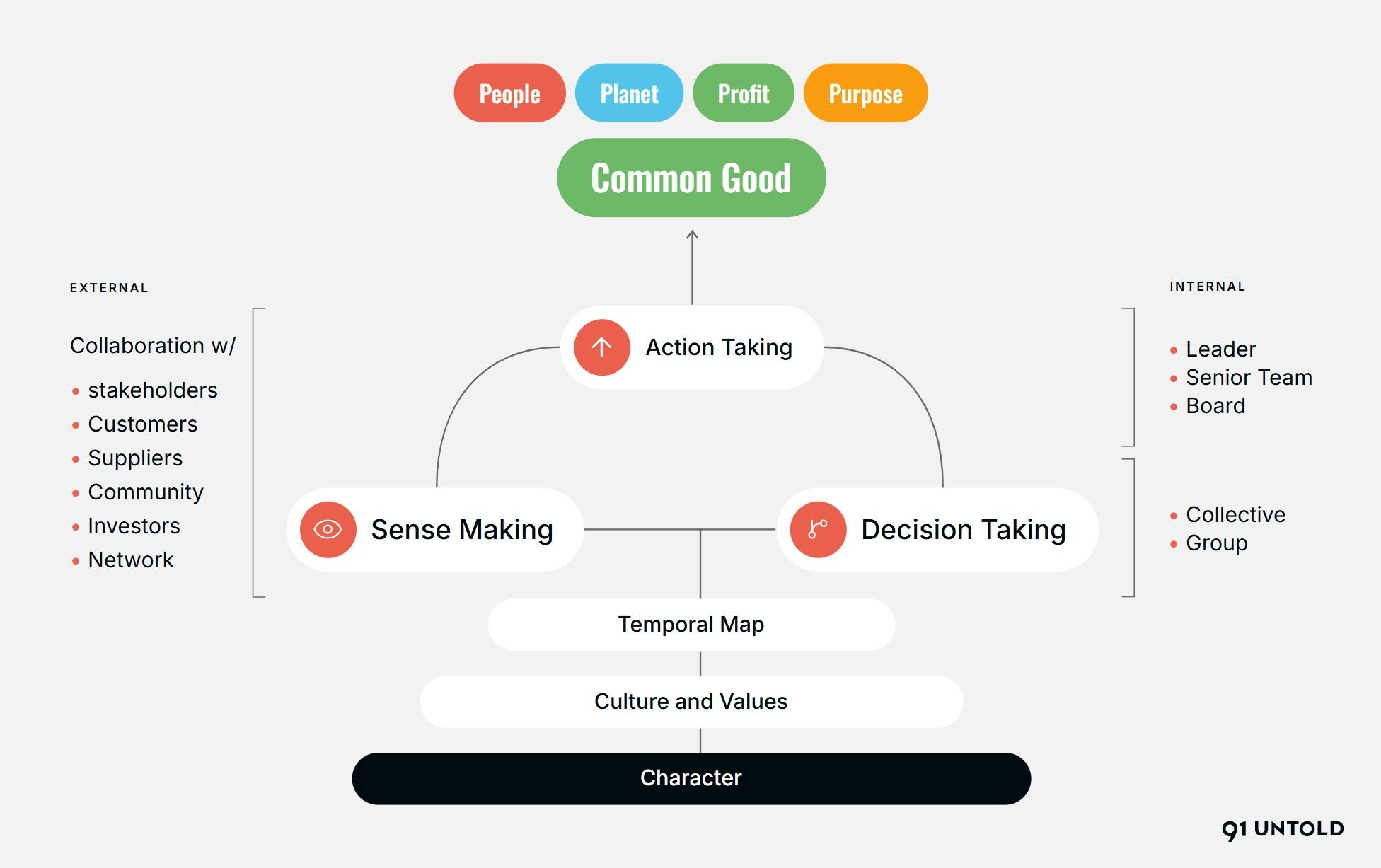
At the base sits character: the raw material that moves an organisation towards wisdom or away from it, whatever process sits on top. Above that come culture and values, then the temporal map I’ve just described, kept agile and light.
Above that again is a triangle of sense-making, decision-taking and action-taking. Around it sit the people involved: customers, suppliers, community, investors, and the wider network on the outside, and the leader, senior team, board, and wider collective on the inside. That triangle is rich enough to deserve its own piece later in this series.
At the top is the point the whole structure exists to serve: the common good, with people, planet, profit and purpose held together, without trading one off against another.
Start at the bottom
What strikes me most now is that the bottom of that pyramid is the part most strategy work skips. You can buy in the analytical layer. You can borrow a template for the temporal map. Character can’t be bought, though, and no template will give you a culture that holds under pressure. Both have to be grown, deliberately, before the rest of the model means anything.
It’s why, in Systemic Navigation, we pay as much attention to the navigator as to the map. A beautiful map in the hands of a team that can’t have an honest conversation about where they are won’t take anyone very far.
For the navigator
If you’re setting strategy this year and reaching for a template, here are some questions worth sitting with first.
- Does your leadership team honestly agree on where you are right now, and when did you last check?
- If each of them described where you’re heading in a single paragraph, would the sentences match?
- How often do you check your position against your direction, and what happens when the two drift apart?
- Is your rigour going into the plan, or into the conversations that shape it?
- Which conversation are you avoiding because it would make the room uncomfortable?
- What does your strategy implicitly require in terms of character and culture, and who is tending it?
- What’s one move, one degree away from how you work now, that would make your direction more alive than your document?
Most organisations, in my experience, haven’t done the work of agreeing on either picture, let alone both. The ones in this study had, and it showed in everything that came after.
This article is part of a short series reflecting on my MBA research into organisational wisdom and strategy among UK B Corps, from a Systemic Navigation perspective.
Neil Almond is Chief Systemic Navigator at 91Untold. Join the conversation at www.91untold.com
Watch & listen

Business: A Force for Good? — Giles Gibbons & Neil Almond
https://untoldpodcasts.podbean.com/e/episode-4-business-a-force-for-good-with-giles-gibbons-neil-almond/More perspectives at 91untold.com/latest-thinking/