Of all the characteristics that came up in my research on organisational wisdom, one kept pulling me back towards territory I already knew well. The literature describes it as the ability to hold paradox and complexity in tension: to think systemically, without reducing a situation to something simpler than it really is. Read that back and it's essentially a definition of systemic thinking, arrived at from a completely different direction.
I don't think that's a coincidence that should be glossed over. It's the clearest evidence I've found that organisational wisdom and systemic thinking are far more than two interests of mine that overlap now and then. They're substantially the same practice, described by two literatures that, as far as I can tell, have never properly spoken to each other.
Inseparable from the system
One line from the research has stayed with me since I first read it: wise leaders need to recognise that they are inseparable from the system in which they reside. In Systemic Navigation we’d push that further. A system is a map you make: a boundary drawn around part of the world, for a purpose, from where you stand. That makes you inseparable twice over. You’re part of the territory you’re mapping, and you’re the one deciding where its edges lie.
This is where wisdom research and systemic thinking meet almost exactly. Both identify the same barrier to good judgement: the instinct to oversimplify, to treat a problem as something that can be isolated, solved and moved on from. Wiser leaders develop the opposite capacity. They investigate connections, notice the patterns running through complexity, and stay curious about what those patterns mean before reaching for the nearest tidy explanation.
Letting go of the positivist reflex
Complexity is a constant for anyone leading an organisation of any size. What separates a wise response from an anxious one is a willingness to loosen the grip on positivist methods, the charts, five-year plans and frameworks that promise certainty, and to sit with uncertainty instead.
That's uncomfortable. Those tools are popular precisely because they're comforting. They make messy, ambiguous territory look measured and under control. Comfort and accuracy are different things, though, and a leader who confuses them tends to make confident decisions about a picture that was never complete.
I explored the same instinct in my piece on strategy as a direction, and the wisdom research gives it a firmer footing. A wise strategy leans less on data alone and on time-tested planning models. It puts people, purpose, and genuine psychological engagement at its centre because these are what actually move an organisation through complexity.
Plans and data still have their place. In Systemic Navigation we'd describe the stance as artefact-light: use the tools, hold them loosely, and keep the real rigour in the thinking and the conversations they serve.
Holding profit and the common good together
Bierly and Kolodinsky (2007) offer a model that makes the point visually. They classify organisations by how far their strategy focuses on increasing shareholder wealth, and how far on influencing the common good. Unsurprisingly, the organisations that hold both together are the ones the research identifies as wisest.
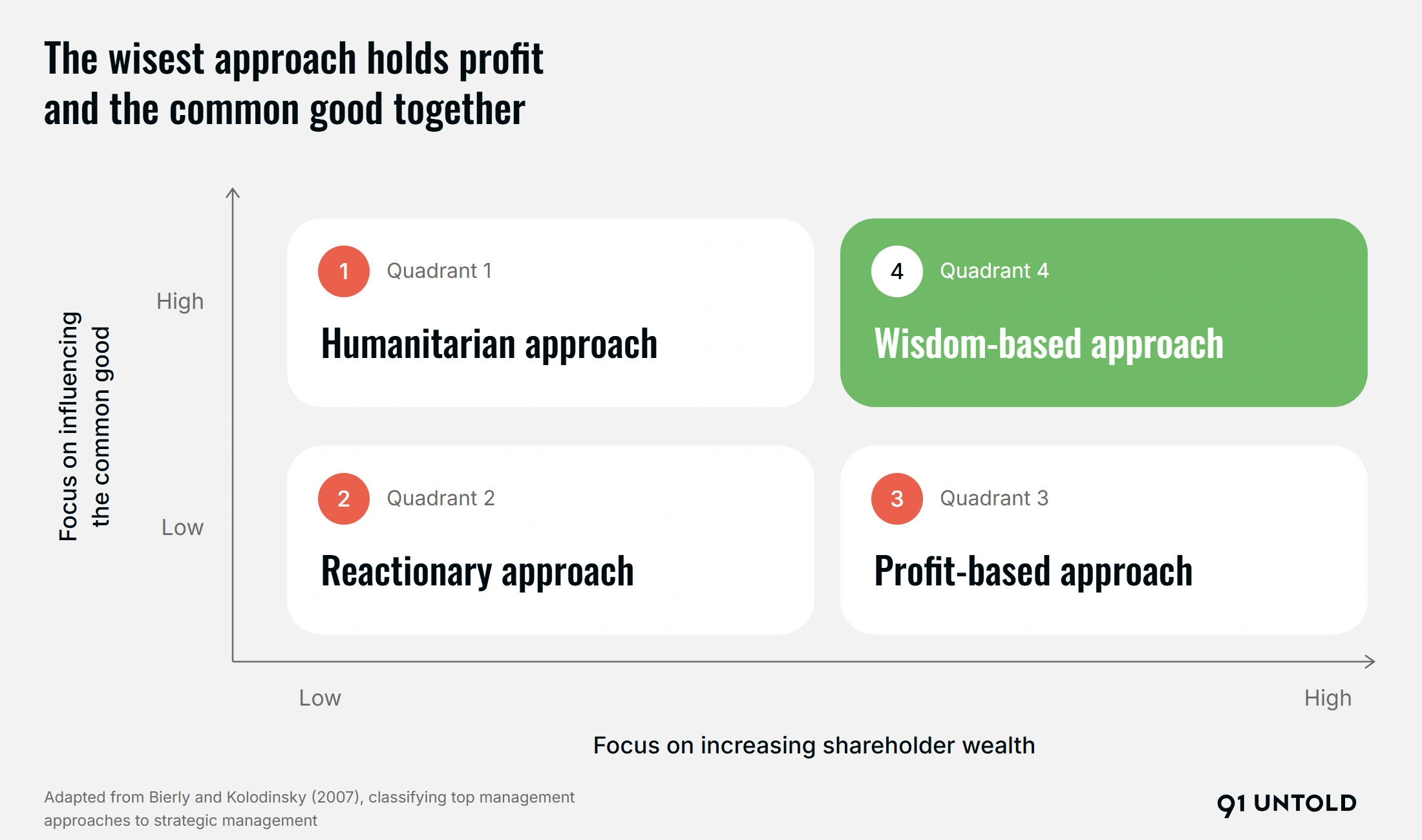
Optimising for one at the expense of the other can look like clarity. In practice, it's a simplification dressed up as strategy. Holding both takes exactly the capacity this article is about: keeping two pulls in tension long enough to find what serves them together.
Trying on other maps
Perhaps the most useful skill this characteristic describes is the ability to move beyond your own viewpoint and genuinely try on an opposing map, staying with whatever tension that creates instead of resolving it too soon.
I've used the mapmaker metaphor for years: the map we make with a client is a map of their territory. The research gives that metaphor a sharper edge. A wise leader accepts that other maps exist, and then goes further. They go and stand inside those maps for a while, long enough to feel what the terrain looks like from there, before coming back to their own.
That's a very different skill from stakeholder consultation as it's usually practised, where other perspectives are gathered, logged and folded into a decision that was largely made already. Holding paradox properly means letting other maps change what you see, sometimes in ways that don't resolve neatly.
The load-bearing characteristic
In the previous piece I described four characteristics of organisational wisdom: an orientation to the common good, a temporal map, perspective-taking and moral maturity. Holding paradox and complexity is the fifth, and arguably the one that carries the weight. It's the capacity that lets an organisation hold the other four together without collapsing them into something simpler and less true.
Without it, a temporal map hardens into rigid long-range planning. Perspective-taking becomes box-ticking consultation. The common good becomes a slogan.
This is why I've never experienced organisational wisdom and systemic thinking as separate strands of my work. In many ways, Systemic Navigation is my attempt to bring those two literatures (amongst others) into the same room: a discipline for seeing systems clearly, practised by people who care what the seeing is for. Wisdom asks what the right thing to do is. Systemic thinking asks how to see clearly enough to know. You can't really do one without the other.
For the navigator
Here are some questions worth sitting with, alone or with your team.
- Where are you treating a problem as separate from the system you're part of?
- Which of your plans or dashboards gives you more comfort than accuracy?
- Where are you optimising for profit or for purpose, when the real work is holding both?
- Whose map have you gathered and logged, without letting it change what you see?
- Which tension in your organisation are you trying to resolve too soon?
- What would change if you treated one paradox as something to hold, for one more week?
This article is part of a short series reflecting on my MBA research into organisational wisdom and strategy among UK B Corps, from a Systemic Navigation perspective.
Neil Almond is Chief Systemic Navigator at 91Untold. Join the conversation at www.91untold.com
More perspectives at 91untold.com/latest-thinking/